Sumiaty Script Handwritten Font for Warm, Playful Branding
I opened a fresh brand board last week for a local ceramicist launching her handmade shop — soft clay tones, linen textures, and that quiet, grounded energy you get from things made slowly by hand. Her brief asked for something “sweet but not cutesy, warm but not saccharine.” I dropped in three script fonts I’d been testing: one too formal, one too jagged, and then Sumiaty. Instant pause. Not because it was perfect on first glance — but because it *felt* like a voice I wanted to listen to longer.
Sumiaty for Handmade Shop Branding and Packaging Labels
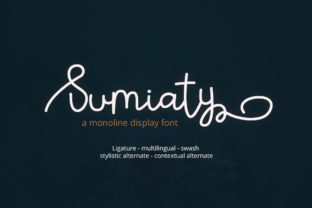
Sumiaty is a Script Handwritten font that breathes — no rigid joins, no forced flourishes. Its baseline sways just enough. Letters lean in gently, like someone leaning across a counter to share a secret. I placed it on a matte kraft label mockup for her mug collection: “Stoneware • Small Batch • Made in Portland.” At 14pt on uncoated paper, the lowercase ‘a’ and ‘g’ held their charm without blurring; the subtle contrast between thick downstrokes and airy upstrokes gave depth without drama. This isn’t a font for dense ingredient lists or legal disclaimers — but for that small serif tagline beneath a logo? Or the handwritten-style “Thank you” stamped on a tissue wrap? Sumiaty lands with sincerity, not affectation.
Sumiaty as a Logo Font for Cafés and Creative Studios
I tested Sumiaty as a primary logo font on a café identity refresh — not a chain, but a single-location spot with chalkboard specials and ceramic mugs. Used at 36pt in all caps (“Haven Coffee”), it kept its casual elegance without collapsing into illegibility. The rounded terminals and open counters stayed clear even when scaled down to 24pt for a laminated menu header. What surprised me was how well it paired with a quiet sans serif (I used a light weight of Inter) for body copy — no fighting for attention, just gentle hierarchy. As a Fonts choice for creative studios or neighborhood service brands, Sumiaty signals approachability without sacrificing craft. It doesn’t shout “look at me”; it says “come in, sit down, let’s talk.”
Sumiaty for Social Media Graphics and Website Headers
On screen, Sumiaty performs best as a display font — hero section headlines, Instagram story text overlays, Pinterest pin titles. I dropped it into a Figma mockup of a homepage banner: “Hand-Poured Soy Candles • Since 2021.” At 48px on white with a soft shadow, the script’s warmth translated cleanly. No pixelation, no awkward spacing gaps — the letterfit feels intentionally relaxed, not technically sloppy. That said, avoid using Sumiaty for navigation menus, blog post titles under 28px, or anything requiring tight vertical rhythm. It’s not built for speed-reading. But for that one line of emotional resonance above a product photo? It’s quietly magnetic.
Sumiaty for Wedding Invitations and Elegant Branding
The phrase “radiates warmth” in Sumiaty is a playfully sweet script that radiates warmth. Get inspired by its casual elegance isn’t marketing fluff — it’s observable behavior. When I set “Emma & Leo • June 14, 2025” in Sumiaty, the lowercase ‘e’ and ‘o’ bloomed softly; the connecting strokes felt like brushstrokes, not vectors. Paired with a delicate serif (Cormorant Garamond Light), it created a balance of intimacy and polish — ideal for wedding stationery, boutique skincare branding, or artisanal chocolate packaging. As a Script Handwritten font, Sumiaty avoids the stiff formality of calligraphic scripts while staying grounded enough for premium positioning. It’s elegant, yes — but the kind that wears linen, not taffeta.
Practical Notes Before You Use Sumiaty in Client Work
Before dropping Sumiaty into final files, test it in context: print a business card at actual size, preview a social post on mobile, check contrast against your brand’s secondary color. Sumiaty works beautifully as an accent or headline Fonts choice — but avoid long paragraphs, small captions, or environments demanding high legibility at distance (like storefront signage over 10 feet). It includes standard OpenType features — ligatures and stylistic alternates — that add nuance when enabled in design apps like Illustrator or Figma. And crucially: always verify the commercial license covers your use case — especially for client work, templates, merchandise, or webfonts. Most Script Handwritten fonts like Sumiaty require extended licensing for digital products or SaaS platforms. A quick check saves headaches later.
If your project calls for personality with presence — not flash, but feeling — Sumiaty earns its place. It’s the kind of Fonts choice that makes clients say, “Yes — that’s *us*,” before you’ve even added the second layer of design.